

Research shows the impact of adding a palatant to just one part of a chunks-in-gravy recipe. In multi-matrix formats such as chunks-in-gravy (CIG), a palatant may be added to either the chunks or the gravy to enhance its taste. However, the effect often extends beyond the targeted matrix, influencing the...

Leveraging Moisture to Improve Dry Pet Food: Palatability
CUSTOMER TECHNICAL INSIGHTS, AFB INTERNATIONAL
Overview
Moisture content (MC) in dry pet food is often underestimated. Manufacturers typically associate it with mold risk, overlooking its impact on palatability.
While the link between MC and kibble palatability is generally acknowledged, it remains rarely quantified, leaving many questions unanswered.
This study provides quantitative insights and practical explanations to address these gaps.
Methodology
We conducted a study to quantify the impact of kibble moisture on palatability in cats and dogs. The following kibbles were used:
• standard cat kibbles dried at 5 % MC, pre-coated with 3 % chicken fat;
• standard dog kibbles dried at 7 % MC, pre-coated with 3 % chicken fat.
Water, chicken fat and palatants were topically applied to the kibbles using a pilot-scale coater. Water levels were adjusted to increase MC by 0.5 %pt, from 4.8 % (control) to 7.8 % for cats, and from 7.6 % (control) to 10.1 % for dogs. Chicken fat was applied at 3 %, followed by 1.5 % dry palatant for cats or 1 % liquid palatant for dogs. Each application step was followed by 1 min of mixing. The coated kibbles were then stored for 10 days before conducting 2-bowl palatability tests in kennels (30 animals, 2 days).
Results
Each MC increment was tested vs. the control kibble, and the results are presented in Figure 1. As the moisture gap widened, intake ratios (IR) favored drier kibbles for cats and wetter ones for dogs. For cats, statistically significant differences emerged from the third test onward (α = 0.05), although a decreasing trend in p-values was already apparent. In dogs, significance was observed from the first comparison.
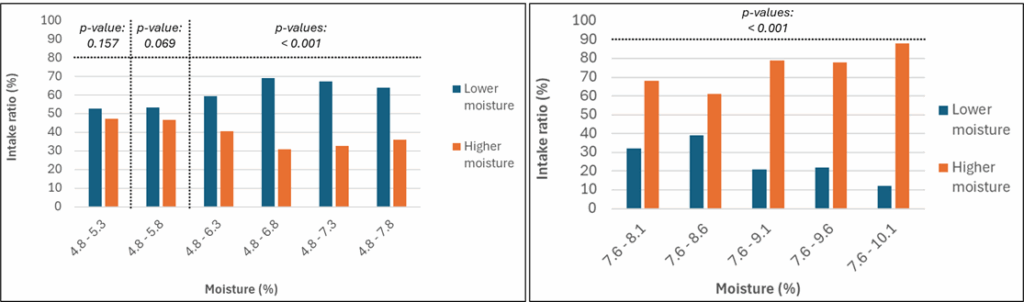
Figure 1. Effect of moisture on palatability for cats (left) and dogs (right).
Figure 2 illustrates the correlation between IR delta and MC delta. A clear negative correlation is observed for cats (left), and a positive one for dogs (right), reinforcing the previous conclusions. The detection threshold lies between 1 and 1.5 %pt of MC for cats, and below 0.5 %pt for dogs. This latter threshold should not be underestimated: 0.5 %pt is actually tighter than the typical variability range of even the most precise industrial dryers. This suggests that dogs may display different preferences within a single batch of kibbles.

Figure 2. Correlation between the difference in IR and the difference in MC for cats (left) and dogs (right).
Lower MC generally leads to harder kibbles, as confirmed by texture analysis. It is also widely acknowledged that cats prefer harder textures (e.g. Éles, Hullár & Romvári1), which may explain their preference for lower-MC kibbles.
At higher MC, the release of volatile compounds increases (e.g. Wolf, Hoyer & Simat2), and since dogs rely heavily on olfaction to choose their food, this likely enhances palatability. Figure 3 supports this: the left panel shows a strong correlation, based on hundreds of kennel data points, between first choice (FC) and IR, suggesting that dogs eat more of the food they initially select by smell. The right panel shows the same correlation for the current MC study only. Since the only variable was MC, this confirms that dogs can detect even slight MC differences using smell alone.

Figure 3. Correlation between IR and FC for dry dog food. Left: all data points collected from our kennel. Right: data points specifically collected from this MC study.
Conclusions & Discussion
MC is a key parameter in dry pet food, with the potential to significantly enhance palatability.
When properly understood, MC optimization is straightforward to implement at factory scale. However, it requires a methodical step-by-step approach to avoid compromising quality or incurring additional costs. These practical aspects are addressed in Parts II and III of this whitepaper.
1 Texture of dry cat foods and its relation to preference. Viktória Éles, István Hullár & Róbert Romvári. Acta Agraria Kaposváriensis, Évf. 18 Szám 1 (2014)
2 Effect of relative humidity on the desorption of odour-active volatile organic compounds from paper and board: sensory evaluation and migration to Tenax®. Nancy Wolf, Sylvie Hoyer & Thomas Joachim Simat. Food additives & contaminants. 40(314):1-18 (2023)
To learn more about this topic, or to speak with our Customer Technical Insights experts, please reach out to your AFB Sales representative or afbinternational.com/contact.